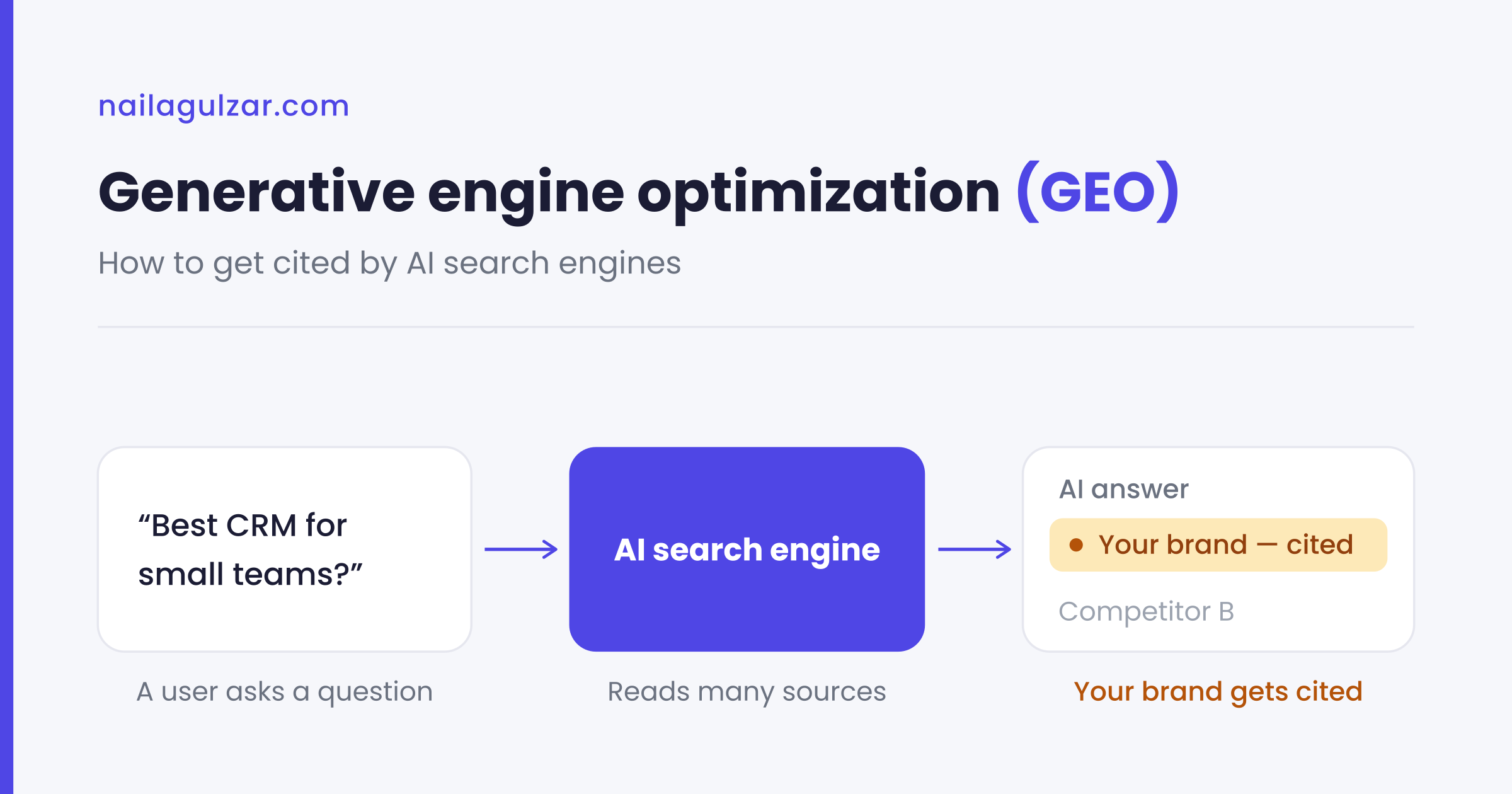

For twenty years, the goal of search engines was simple: rank on page one of Google search. You earned the link, the user clicked, and the website traffic was yours. That contract is quietly breaking. Increasingly, your buyer never sees a list of ten organic search results. They ask an AI tool (ChatGPT, Perplexity, Gemini, or Google’s AI Overviews) a question, read an AI-generated summary, and act on it, often without clicking anything at all.
Generative engine optimization (GEO) is the practice of structuring your content and your wider online presence so that AI systems cite, mention, and recommend you inside those AI-generated answers. If traditional SEO was about winning the ranking, GEO focuses on winning the sentence.
I’m Naila Gulzar, a content writer who helps businesses get mentioned in AI search engines, so this is the work I do every week, not a theory I’m admiring from a distance. This guide is written for people who actually have to do the work. I’ve kept the definitions tight, included the copy-and-paste examples competitors leave out, flagged honestly what’s proven versus what’s still marketing, and shown you how to track GEO performance even without a budget for enterprise AI tools.
TL;DR
- GEO = optimizing content to be cited by AI search engines (ChatGPT, Perplexity, Gemini, Google AI Overviews, Claude), not just to climb traditional search rankings.
- It goes by several names: answer engine optimization (AEO), AI optimization (AIO), large language model optimization (LLMO), and generative search optimization. As of early 2026, there’s no agreed academic line between them; in practice they describe the same goal.
- The stakes are real: Ahrefs’ most recent analysis (December 2025) found that AI-generated summaries are linked to roughly 58% lower click-through rates on the top organic result (Ahrefs), up from 34.5% just eight months earlier. The clicks are shrinking fast; the answer is becoming the destination.
- Most of your AI visibility will not come from your own website. Industry analyses put the majority of brand mentions in AI responses on third-party sources: Reddit, YouTube, Wikipedia, review sites, and listicles.
- Small and medium-sized businesses can absolutely compete by specializing content around specific topics and building topical authority that AI systems reward.
- You don’t need a four-figure tool subscription to start. A spreadsheet and ten well-chosen user queries will tell you where you stand this week.
What Generative Engine Optimization Actually Is
Generative engine optimization is the work of making your brand the source an AI chooses to summarize, quote, or recommend when someone asks a question in your category.
Note the verb. You are not trying to rank a page. You are trying to be selected from among the multiple sources a model pulled, then represented accurately in a few sentences of generated text. Those are different problems, and they need a partly different toolkit.
It helps to clear up the vocabulary, because the space is drowning in acronyms:
- GEO (generative engine optimization) is the umbrella term, popularized by a 2024 research paper from Princeton and IIT Delhi.
- AEO (answer engine optimization) is the same idea, framed around the “answer engine.”
- AIO / LLMO / generative search optimization are AI optimization, large language model optimization, and generative search. Different labels, near-identical goal.
Don’t get pulled into terminology debates. They’re mostly vendors planting flags. When a client asks me which acronym to “do,” I tell them the work is the same regardless of the label: be findable, be citable, and be trusted by the AI systems that now sit between your buyer and your website.
What GEO is not: it is not a replacement for traditional SEO, and it’s not a magic trick. A well-structured, authoritative, technically sound website is the precondition for GEO, not an alternative to it. Both rest on many of the same principles. If your SEO house is on fire, fix that first.
Why GEO Matters Now: Generative AI Is Reshaping Search Engines
A few shifts in the search landscape have stacked up at once.
A) Discovery is moving into AI-powered search experiences.
ChatGPT now serves on the order of 900 million weekly users, and Google’s Gemini app has crossed roughly 750 million monthly users. Google itself has folded generative AI features into google search; AI Overviews already appear on a meaningful share of search results. For a growing slice of users, the AI-generated answer is the search result.
B) The clicks are draining out of organic search results.
This is the number every marketer should sit with, and the one I open most client conversations with: Ahrefs’ study found that the presence of AI-generated summaries is associated with a 58% lower click-through rate on the top-ranking organic result, nearly double the 34.5% they measured in April 2025. AI Overviews answer the question on the page, so fewer people travel to your site. GEO is how you stay visible even when the click disappears, by being inside the answer rather than below it.
C) B2B buyers, especially, start with AI search.
In G2’s 2025 buyer-behavior research, roughly 30% of buyers said they now begin with an AI tool before Google, and close to half use AI for market research. Among large enterprises, that figure climbs higher. The bigger the deal, the more likely generative AI search is shaping the shortlist.
D) The AI traffic that remains is unusually valuable.
Here’s the counterintuitive part. In Ahrefs’ own analysis, ChatGPT drove only about 0.5% of their visits, but those visits accounted for roughly 12% of new signups, many times the site average. By the time someone clicks through from an AI-generated response, the model has already framed the category, weighed options against their user intent, and pre-qualified them. They arrive as qualified traffic, ready to evaluate, not browse.
Put bluntly: GEO is becoming the layer where buyers decide who’s even in the running, invisibly, before any analytics tool registers a thing.
How AI Search Engines Build Generative AI Answers
Tactics make no sense until you understand the machine. Generative engines do not match a keyword to a page the way traditional search engines do. Roughly, here’s what AI models do when someone asks a question:
- Intent analysis. The system reads the search intent: is this informational, comparative, or transactional?
- Query fan-out. It silently expands one question into many related user queries. “Best CRM” might become “affordable CRM for small business,” “CRM with built-in automation,” “CRM comparison for startups,” and a dozen more.
- Retrieval. For each variation, it pulls a handful of sources, frequently between five and sixteen per answer, depending on the AI platform.
- Synthesis. It evaluates those multiple sources for relevance, authority, and freshness, then uses natural language to create responses: a single coherent answer with citations embedded at varying positions.
Two consequences fall straight out of this:
- You can’t win by optimizing one keyword. The model tests you against a whole fan of related questions, so you need breadth and depth across your topic, not a single tuned page.
- You’re competing to be one of a small set of trusted sources, and the set is rebuilt from scratch every time someone asks. Which is why AI visibility is famously volatile (more on measuring that below).
The Honest Part: GEO Strategies, Proven vs. Hype
Most guides skip this. I won’t, because credibility is the entire game here, both for your brand and for the content you publish. It’s also the part I get asked about most, usually after a client has been pitched a “guaranteed AI ranking” by someone who shouldn’t be trusted with it.
What has real evidence behind it:
The original Princeton/IIT Delhi study tested specific tactics across thousands of queries and found that citing sources, adding statistics, and including relevant quotations produced the largest visibility gains, improvements in the 30 to 40% range for the top methods. That’s the strongest empirical anchor the field has, and it lines up with a clear principle: content must be easily attributable to a reliable source to earn a citation.
Large-scale industry analyses (AirOps, Athena, Profound) consistently show that structure, structured data, freshness, and off-site presence correlate with being cited. AI systems prioritize content from reputable sources and verified, relevant information.
What deserves a raised eyebrow:
That seminal study drew fair criticism over its use of simulated data and the heavy overlap between “GEO tactics” and plain good SEO. Several winning tactics are simply writing well and backing up your claims.
A lot of vendor “research” exists to sell you a tool. Treat single-vendor statistics as directional, and look for the same finding across multiple sources before betting a quarter’s strategy on it.
The grown-up takeaway: GEO is mostly excellent SEO strategy and content creation, re-pointed at a new consumer. The genuinely new parts are off-site citation building, AI-specific measurement, and a heavier emphasis on machine-readable structure. If a guide promises a secret “GEO hack,” close the tab.
Generative Engine Optimization vs. Traditional SEO: The Key Differences
They share most of their DNA: quality content, technical health, authority, and E-E-A-T all still matter, and both follow the same principles of serving real user intent. Here are the key differences.
| Traditional SEO | Generative Engine Optimization (GEO) | |
| Goal | Rank in the SERPs | Appear in AI-generated answers |
| Unit of success | A click | A sentence of generated text |
| What you optimize | Mostly your own domain | Your domain plus the wider web AI learns from |
| Primary signals | Keywords, backlinks, search rankings | Citations, brand mentions, sentiment, structure |
| Where you compete | The SERP | Reddit, YouTube, Wikipedia, review sites, and the SERP |
| How you measure | Rankings, organic traffic | AI visibility, citation frequency, sentiment |
The single most important row is the third one. In SEO you control the playing field: it’s your site. In GEO, multiple analyses suggest the majority of brand mentions inside AI responses come from third-party sources you don’t own. You can write the best page on the internet and still lose if your category lives on Reddit and you’ve never shown up there.
The GEO Playbook: Optimizing Content for AI Search
Here’s the work, grouped into four areas. I’ve included concrete artifacts (a before/after rewrite, schema, and crawler rules) because “add structured data” is useless advice without an example.
1. Make Content Extractable for AI-Generated Answers
AI rewards content it can lift a confident answer from. The most reliable pattern for creating content that gets cited:
Give a direct answer in the first 40 to 50 words, before any throat-clearing. Content should directly answer potential user questions with clarity and accuracy.
Follow with a short “why it matters” paragraph, then the deep explanation. This logical flow gives the model an extractable snippet up top and the depth it needs to trust you.
Be fact-dense. Specific numbers, named sources, dates. Structured data and clear formatting help publishers segment articles into bite-sized facts for easy extraction. Vague prose doesn’t get cited; verifiable, relevant information does.
Use long-tail, question-based keywords. Phrasing content around the actual questions people ask helps AI understand and match it to user queries.
Use clean heading hierarchy and bullet points. One H1, logical H2s and H3s. AirOps found pages with sequential, logical headings were cited at meaningfully higher rates, and the large majority of cited pages used a single H1.
Here’s the difference in practice.
Before (human-pretty, AI-invisible):
When it comes to choosing the right project management tool, there are many factors to consider, and every team is different, so the answer really depends on your unique situation and what you’re hoping to achieve.
After (AI-citable):
The best project management tool for small remote teams in 2026 is one that combines async updates, built-in time tracking, and a free tier. Tool X, Tool Y, and Tool Z lead on those criteria. Here’s how they compare on price, integrations, and learning curve.
The “after” version states a direct answer, names entities, and signals exactly what follows. A model can quote it. The “before” version says nothing a model can use. This single shift, leading with the answer instead of burying it, is the edit I make most often when I take over a client’s existing content, and it’s usually the one that moves the needle first.
2. Get the Technical Foundations and Structured Data Right for AI Engines
This is unglamorous and decisive. If the AI engines can’t access or parse your content, nothing else matters. Using structured data makes existing content easier for AI assistants to analyze and synthesize. The very first thing I check on any client audit is whether their robots.txt is quietly blocking the bots that feed these systems. More often than you’d expect, it is, and they’ve been invisible to AI without knowing why.
Let AI crawlers in.
Check your robots.txt isn’t accidentally blocking the bots that feed these AI systems. At minimum, confirm access for GPTBot, Google-Extended, ClaudeBot, and PerplexityBot:
User-agent: GPTBot
Allow: /
User-agent: Google-Extended
Allow: /
User-agent: ClaudeBot
Allow: /
User-agent: PerplexityBot
Allow: /
Add schema markup.
Structured data helps machines understand what your page is. Organization, Article (with a real author), Product, and especially FAQ schema are high-value. Minimal FAQ example:
{
  "@context": "https://schema.org",
  "@type": "FAQPage",
  "mainEntity": [{
    "@type": "Question",
    "name": "What is generative engine optimization?",
    "acceptedAnswer": {
      "@type": "Answer",
      "text": "GEO is the practice of structuring content so AI search engines like ChatGPT and Google AI Overviews cite and recommend it."
    }
  }]
}
Keep content fresh.
Freshness compounds. AirOps reported that pages not updated on roughly a quarterly cadence were several times more likely to lose citations, and most cited pages had been refreshed within the past year. Set a refresh schedule for your money pages and treat it as non-negotiable; changing AI algorithms require constant adjustments.
Consider an llms.txt file.
An emerging convention: a plain-text map at your root pointing AI systems to your most important content. Adoption is early, so treat it as low-cost insurance, not a silver bullet.
3. Build Brand Visibility Off Your Site (AI Visibility)
This is where GEO departs hardest from traditional SEO, and where most brands underinvest. It’s also the part of my job that surprises clients most: I spend as much time getting them accurately represented off their website as on it. Multiple analyses converge on an uncomfortable truth: most of your AI visibility comes from places you don’t control. AirOps attributes the large majority of brand mentions in AI answers to third-party sources rather than the brand’s own domain.
So where do AI models actually learn? Athena’s analysis of millions of AI responses found the top-cited domains skewed heavily toward:
Reddit, by far the largest single share of top-cited domains.
YouTube, second, driven mostly by educational, non-branded content (and increasingly the audio and sound clips inside those videos).
Wikipedia, foundational definitions and entity context.
Forbes, LinkedIn, and review sites (G2, Capterra, TrustRadius), professional validation and comparison data.
Practical moves:
Show up where your category is discussed on Reddit and YouTube, genuinely and helpfully, not as a drive-by ad. AI cited community content because it reads as authentic. This is where social media marketing and GEO overlap.
Get into the listicles and comparison pages that already rank. Profound found roughly a third of LLM citations came from comparative “best-of” content. Moving from #6 to #3 on a list AI already trusts often beats publishing a new page.
Don’t obsess over dofollow links. For AI visibility, AirOps found nofollow and dofollow links correlated almost identically; the model treats a link as a recognition signal, not authority transfer. The mention matters more than the link attribute.
4. Build Topical Authority, Entities, and Trust
AI weighs who is speaking. Anonymous, thin content gets passed over, because AI systems prioritize content that demonstrates high topical authority.
Give every important page a real, credentialed author with a bio and an author page.
Be consistent about your brand’s facts across your site, social profiles, and third-party listings. Contradictions confuse AI models and invite hallucinated answers about you.
Specialize. This is how small and medium-sized businesses win, and it’s the strategy I lean on hardest for the smaller brands I work with. You won’t out-authority a giant on a broad term, but you can become the recognized source on a specific topic, and AI systems reward that depth.
Different Verticals, Different Rules
Generative engines don’t apply one rulebook everywhere, and your GEO strategy should reflect the vertical:
Health and medical queries: health-oriented engines lean hard on authoritative sources and clear question-and-answer formatting. Q&A structure and credentialed authorship aren’t optional here.
News and current events: news sites increase their citation likelihood by publishing timely, expert-driven content. Recency is a ranking factor of its own.
Commercial and B2B: comparative and decision-support content (alternatives, comparisons, best-of lists) earns a disproportionate share of citations.
How to Measure GEO Performance and AI Visibility Without an Enterprise Budget
Tracking AI search visibility requires new metrics beyond traditional SEO: citations, brand mentions, and sentiment, not just rankings and traffic. The big platforms make this easy and expensive: Semrush’s Enterprise AIO tracks brand mentions and sentiment across AI searches, HubSpot’s AI Search Grader scores your generative SEO performance, and tools like Profound, AirOps, and Athena go deeper still.
But you don’t need any of them to start. Here’s the exact free method I run for new clients before they spend a rupee on tooling. Any solo consultant or SMB can do it this afternoon.
Step 1: Write your 10 to 20 “golden prompts.”
The real questions a buyer would type. Favor bottom-of-funnel phrasing:
- “Best [your category] for [specific use case]?”
- “[Your brand] vs [competitor]: which is better for [audience]?”
- “What’s a good alternative to [competitor]?”
Step 2: Run each prompt in a fresh, logged-out session
Run each prompt across ChatGPT, Gemini, Perplexity, Claude, and Google AI Overviews. Logged-out and incognito matters; personalization skews results otherwise.
Step 3: Log it in a simple spreadsheet:
| Prompt | AI platform | Did you appear? | Position (1st / mid / last) | Sentiment (pos/neu/neg) | Sources cited | Anything wrong? |
Step 4: Track three things over time:
Visibility: how often you appear at all (your rough share of voice).
Citation: whether the answer actually links to you, and via which source.
Sentiment and accuracy: is the model describing you correctly? Watch for hallucinated pricing or features; correcting those is urgent.
Run it monthly. Because AI-generated responses are volatile, measure across many runs, not a single snapshot; a brand can drop from an answer one minute and return the next. Watch the trend, not the blip.
Who Should Prioritize Generative Search Optimization Now
GEO is not equally urgent for everyone. A quick decision filter:
Prioritize it now if:
You sell something people research before buying (software, services, considered purchases, B2B anything).
Your buyers are technical, professional, or enterprise, the segments adopting AI-driven search fastest.
You compete in a category full of comparison and “best of” queries.
It can wait (a little) if:
You’re a hyper-local business found mainly via Maps and word of mouth.
You depend on impulse or transactional purchases with little research.
Your SEO and site fundamentals are still broken; fix those first, they’re the foundation GEO is built on.
Even in the “can wait” cases, the floor-level hygiene (accurate listings, clean structure, crawler access) is worth doing now, because it costs little and compounds.
Common GEO Mistakes in AI-Driven Search
Optimizing for AI at the expense of human readers. This is the big one, and the line I hold firmest in my own work. If your content reads like it was assembled for machines, you’ll win citations and lose customers. Write for people first; structure for AI second.
Treating GEO as a one-time project. Models rebalance constantly. It’s an ongoing discipline, not a launch.
Optimizing only your own site. You’d be ignoring the majority of where AI forms its opinion of you.
Chasing one AI platform. Perplexity leans heavily on community sources; Gemini far less so. Optimize for the ecosystem, not a single model.
Publishing thin glossary pages. Definitions get absorbed straight into the AI-generated summary with no click-through. Put definitions in FAQ schema and spend your energy on decision-support content.
Buying the hype. If a tactic sounds like a loophole, it’s either already priced in or about to be patched. Durable GEO is durable quality.
FAQ
Is GEO replacing traditional SEO?
No. GEO sits on top of SEO and depends on it. Good technical and content SEO is the precondition for being cited by AI engines. Think of GEO as an additional visibility layer, not a replacement.
How long does GEO take to show results?
Expect a few months of consistent work before you see meaningful, stable AI visibility, and expect that visibility to fluctuate even once you have it. Off-site authority, in particular, builds over weeks, not days.
Do AI search engines and Google rankings overlap?
Less than you’d think. Independent analyses found only a minority of AI-cited URLs also rank in Google’s top results for the same query, commonly somewhere between 10% and 40% depending on the model. Ranking #1 does not guarantee you’ll appear in AI-generated answers.
What’s the single highest-leverage GEO move for a small business?
Get accurately represented on the third-party sources AI already trusts in your niche (the relevant subreddit, comparison sites, review platforms) and make your own key pages answer real questions directly in their first lines.
Can I do GEO without paid AI tools?
Yes. Start with the spreadsheet method above. Paid platforms like Semrush Enterprise AIO or HubSpot’s AI Search Grader save time and scale measurement, but they don’t change the fundamentals.
The Bottom Line
GEO isn’t a new religion that replaces everything you know about digital marketing. It’s the recognition that an AI now sits between your buyer and your website, summarizing your category, answering the question on its own page, and quietly building a shortlist, and that you can influence what it says. Most of that influence comes from genuinely excellent, well-structured, verifiable content, published not just on your own site but across the wider web these AI models learn from.
The brands establishing AI visibility now are compounding an advantage that gets harder to displace each quarter. The window is open. And the work is mostly work you already know how to do, pointed at a new audience that happens to be a machine.
Sources I used for research
- Ahrefs, Update: AI Overviews Reduce Clicks by 58% (December 2025, most recent): https://ahrefs.com/blog/ai-overviews-reduce-clicks-update/
- Ahrefs, AI Overviews Reduce Clicks by 34.5% (April 2025, earlier baseline): https://ahrefs.com/blog/ai-overviews-reduce-clicks/
- Ahrefs, Does AI Search Traffic Convert Better Than Traditional Search? 0.5% of Visitors Drove 12.1% of Signups: https://ahrefs.com/blog/ai-search-traffic-conversions-ahrefs/
- Aggarwal, Murahari, Rajpurohit, Kalyan, Narasimhan & Deshpande, GEO: Generative Engine Optimization (Princeton, IIT Delhi, Georgia Tech, Allen Institute for AI; KDD 2024), arXiv:2311.09735: https://arxiv.org/abs/2311.09735
